
Expanding in-house technologies and services with Planmeca
Dr Ceri Owen-Roberts is the Principal of Elgin Park Dental Practice in Bristol, England. He has a particular interest in restorative dentistry and dental implants. In the following article, Dr Roberts explains how he came to equip his clinic with a Planmeca CBCT unit.
With a focus on dental implants and oral surgery, I used to frequently refer my patients out to colleagues for CBCT scans. These are necessary for accurate diagnostics and treatment planning and offer greater visualisation than plain film. However, as my implant business grew, it was clear from the number of referrals being made that we would benefit from being able to perform CBCT scanning in-house. The benefits wouldn't only be financial either. In some cases, the ability to take a CBCT and get the results immediately, without sending the patient elsewhere first, can be a huge advantage. I, therefore, decided to introduce the technology into the practice.
Preparation for the project
We worked with a design company to organise and complete the refurbishment. Our preferred local building company were responsible for the construction work.
During this phase of the project, the main challenges faced were not unexpected. The nature of the old building meant that the walls were thick, solid stone, making them difficult to cut into. While the internal parts of the building didn't require any planning permissions, even the smallest of changes to such an old building is always very involved. It was a combination of design recommendations and my own market research that led me to select a CBCT machine from Planmeca. The Planmeca ProMax® 3D Max was one of the few scanners that were compact enough to fit into the small space we had available.
I was also impressed with the quality and abilities of the software, which seemed to meet my needs and enable me to deliver the highest standard of treatment. Crucially, this CBCT achieved high image quality with the Planmeca Ultra Low Dose™ technology, encouraging a safe yet effective imaging procedure. In addition, the offer of excellent technical support bolstered my final decision.
The design company installed the CBCT while liaising with Planmeca very efficiently to ensure everything went smoothly. Planmeca then conducted comprehensive staff training and has since provided brilliant support. The team are easy to contact with any queries we might have and have been a pleasure to work with.
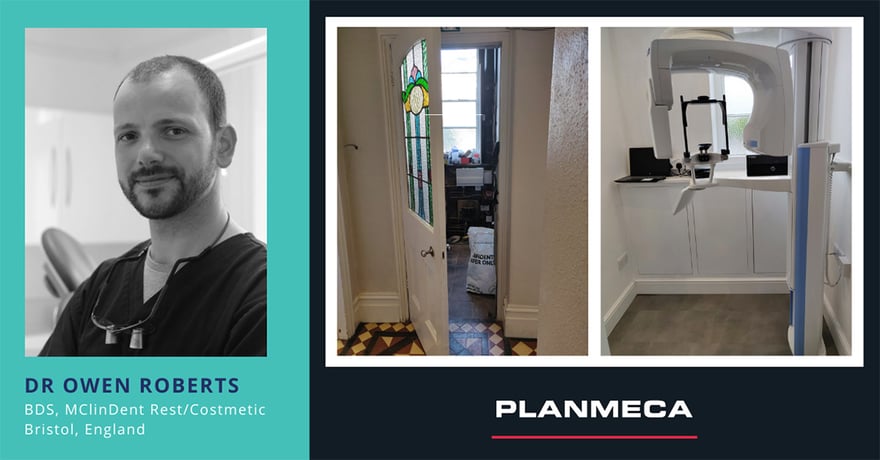
The outcome: 8 months later
Having eliminated the need to refer patients out for CBCT scans, we can now perform imaging during consultations and discuss the results with patients straight away. This has led to a quicker and more efficient service, while also having a positive influence on the profitability of the practice.
As far as patients are concerned, the new CBCT is an extension of the services we already offered, providing them with more in-house. We have also marketed our CBCT scanning facilities as a new service available by referral and we receive referrals from several local practices.
Upon reflection eight months later, I wouldn’t do anything differently. I am most proud of the fact that we can take such high-quality scans with a low radiation dose. Making the decision to invest in a CBCT is made all the easier with the assurance that you can see all the relevant anatomical structures at a fraction of the radiation dose of a traditional CT.
For my work with dental implants and oral surgery, this has been invaluable.
For any other practitioners looking to invest in an in-house CBCT, I would strongly recommend researching radiation doses for the equipment they’re considering. I would also advise looking at independent research rather than the manufacturer’s publications to get an unbiased and more accurate picture. Finally, I would recommend having a contingency budget when looking to renovate an old building in a conservation area, as there are always unexpected costs!
Dr Ceri Owen-Roberts is the Principal of Elgin Park Dental Practice in Bristol, England. He has a particular interest in restorative dentistry and dental implants. Dr Owen-Roberts is a member of the International Team of Implantologists and a study club director for the Bristol region.

.jpg)