
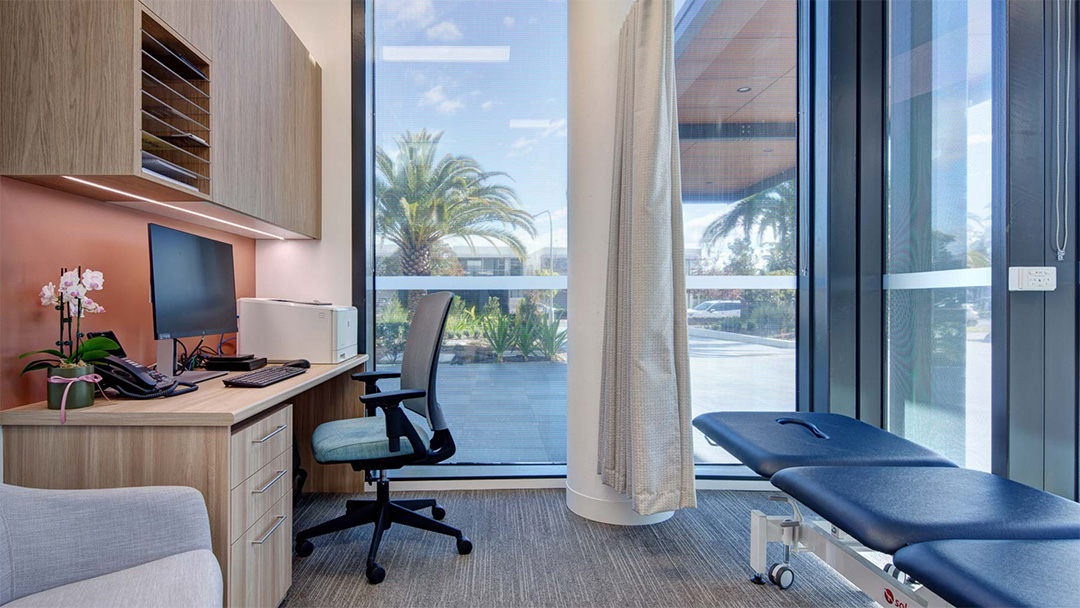
Globally, the healthcare sector emits 4.4% of net yearly emissions, around the same as 514 coal-fired power plants. Interestingly, as well as these traditional measures, attention is turning towards “social sustainability” to improve wellbeing in society.
As a healthcare design company with sustainability front of mind, we look at what it means to have a healthy and sustainable healthcare practice in today’s world.
According to Open Sourced Workplace, a sustainable workplace establishes the “goal of balancing the planet, people and profit to produce success and viability in the long-term.” True sustainability requires a holistic approach that covers healthcare practice design, construction methods and sustainable activities. A good place to start is an audit of the existing or proposed facility. Look at your current energy consumption levels, energy leaks, waste and the environmental impact of the healthcare practice operations.
Benefits of a sustainable healthcare practice
The Green Business Bureau outlines the main benefits that can be enjoyed by a sustainable healthcare practice:
- Lower utility bills and other operational costs
- Elevated brand and positive image
- Greater employee satisfaction and retention
- Patient and community trust
- Lower carbon footprint and environmental impact
Building sustainability rating systems
In Australia, Green Star and NABERS are the primary building sustainability rating systems to use as benchmarks.
Green Star assesses the sustainability attributes of a project through impact categories. Australia’s first Green Star-rated healthcare facility is the Flinders Medical Centre New South Wing in Adelaide. Compared to an equivalent benchmark building, energy consumption is 42 per cent less, energy costs are $400,000 less and water consumption is 20 per cent less. Site wide, CO2 emissions reduced by 4,160 tonnes, equivalent to taking 810 cars off the road for an entire year.
NABERS is the national rating system that measures the environmental performance of Australian buildings and tenancies with a rating system from one to six stars for energy, water, waste and indoor environment.
Social sustainability – improve wellbeing in society
The WELL Building Standard is a vehicle for buildings and organisations to deliver more thoughtful and intentional spaces that enhance human health and wellbeing. Healthcare practice design is therefore paramount.
International WELL Building Institute Chairman and CEO, Rick Fedrizzi, and President, Rachel Gutter, both highlight a second wave of sustainability that "focuses on human performance, and must build on top of the first wave that focused primarily on building performance".
Fedrizzi and Gutter state that the green building movement brought together the energy efficiency market that lowered greenhouse gas emissions of buildings that accelerate climate change, and the WELL Building Standard (WELL) is now repositioning sustainability through a more human-focused lens to advance human health on a global scale.
WELL can help healthcare practices advance the UN Sustainable Development Goals through objectives around air, water, nourishment, light, movement, thermal comfort, sound, materials, mind and community.
Sustainability trends in healthcare
Healthcare company Dassiet is known for its work around developing functional and sustainable supermaterials. Manager of Design, Marketing and Digital Development, Kerkko Visuri, outlines recent healthcare sustainability trends as:
- Renewable energy such as solar roof panels
- Reduce the use of latex
- Reduce chemical exposure especially floor wax
- Implement a building automation system for better efficiency, reduced cost and waste
- Optimise the supply chain, eliminating overstocking and cutting down on the environmental impact of transportation
- Medical recycling
Sustainable healthcare fitouts
A new healthcare fitout is a great opportunity to create a more sustainable practice. Consider the following:
- Lighting alone accounts for around 18% to 40% of electricity usage in commercial premises. Add occupancy sensors to automatically switch lights on/off and responsive lights that change according to the amount of daylight. LED lights are a good solution for cost and energy savings.
- Reduce water usage and bills with low-flow aerator taps and low flush toilets. Aerator taps mix air into the water to give the impression of a heavier flow, but they use as little as 2 litres per minute, one third of a standard tap. And new-style toilets will typically use 3.5L per flush compared to 12L for an old single-flush toilet.
- Installing showers and bicycle lockups will encourage staff to cycle to work, rather than using cars or buses. A fitter, healthier workforce is a more motivated one.
Minimising the use of volatile organic compounds and semi-volatile organic compounds reduces the negative health impacts associated with these products. Our team at Evoke Projects can advise you on sustainable choices of insulation, paints, coatings, adhesives, furniture and furnishings, composite wood products and flooring materials for your healthcare fitout.
Even a minor healthcare practice refurbishment can make a world of difference, such as resealing windows and doors or adding energy efficient ceiling fans.
Please call the design and fitout experts at Evoke Projects on 1300 720 692 for more information about sustainable healthcare practice design, or speak to a Credabl consultant.

.jpg)