
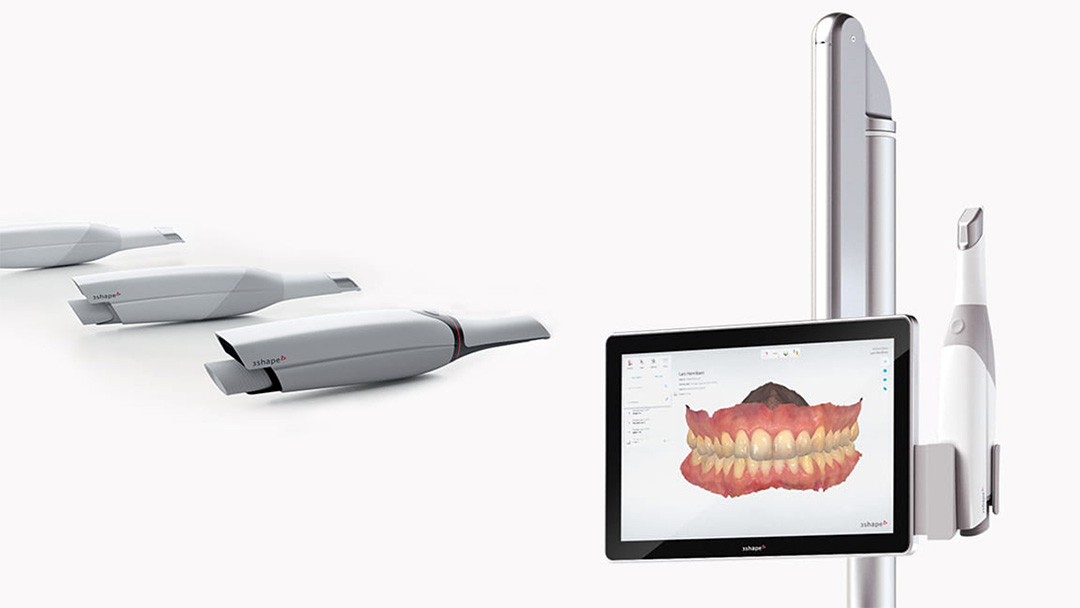
The utilisation of a full digital workflow eliminates the disadvantages and difficulties commonly associated with conventional analog techniques.
Some of these common limitations include patient discomfort commonly associated with the impression procedure, the potential for distortion of the impression material and inaccuracies of subsequent steps in the manufacturing process, the potential of damage to the dental cast and delay, due to logistics of sending lab work between the dental practice and the laboratory.
These disadvantages do not occur in the full digital workflow where the impression is taken with an intraoral scanner and the design of the prosthesis is done on CAD software. The data from the digital impression is also simply sent over the internet, significantly reducing the time needed to manufacture the wax-ups and prosthesis.
The following case report presents a fully digital workflow from the treatment planning to the guided surgery phase in the provision of an immediate implant retained fixed provisional bridge.
There are many advantages of a fixed provisional over a removable provisional that includes:
-
stability of the prosthesis and associated implants
-
aesthetics
-
less interference of speech patterns
-
better mastication and comfort for the patient
- most importantly, minimize soft tissue complications associated around the peri-implant site
Case information
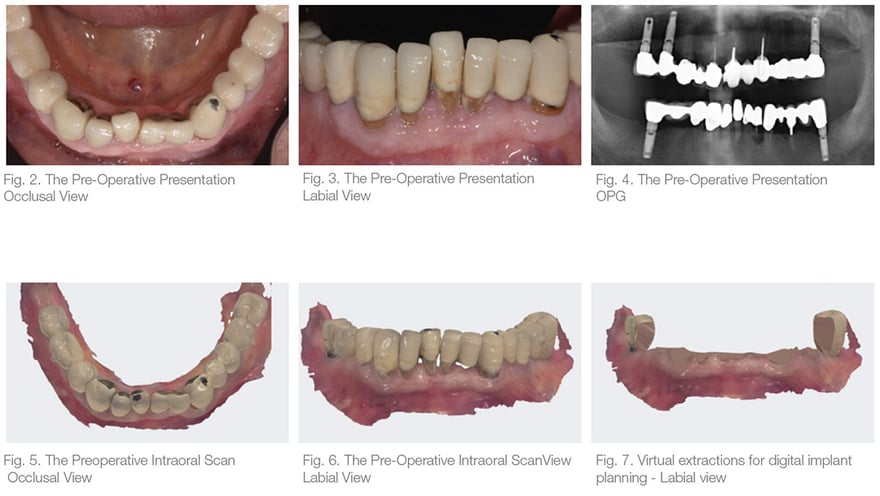
A patient in his early 80s presented with the chief complaint of recurrent pain, discomfort and swelling from his lower dentition. An examination revealed moderate to advanced bone loss of his remaining mandibular teeth.
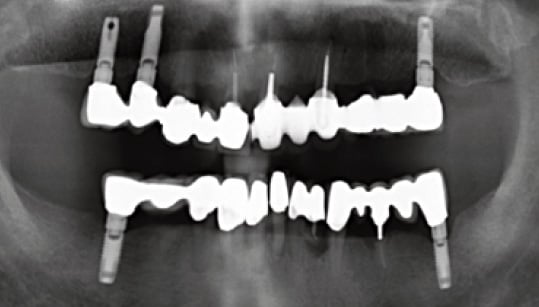
Peri-apical radiolucencies associated with chronic apical periodontitis were also diagnosed on the lower anterior segment. His lower dentition at the time of presentation was restored with fixed crown and bridge prosthesis with implant fixtures on the 37 and 47 site, placed 20 years prior. The implant fixtures were abutments for fixed bridges that were linked to natural teeth abutments (Fig. 1).
The patient’s health history was unremarkable. The patient requested for his lower dentition to be rehabilitated with the use of dental implants due to his good perception of longevity stemming from his past treatment experience.
It was the patient's brief and request that the procedure be simple and not time consuming due to several factors, including:
- his struggle to keep his mouth open for long periods of time
- difficulty in tolerating conventional impression techniques
- his perceived age and health status
In treatment planning the case, the following criteria were established with the goal of delivering a fixed implant retained provisional bridge.
-
To deliver the complete treatment process in three appointments with the appointments being:
The consultation and treatment planning phase utilizing intraoral scanning with the 3Shape TRIOS intraoral scanner, BioHorizon’s Digital Library, 3Shape Implant Studio and a CBCT from Instrumen-tarium Maxio OP.
Extraction of all lower natural teeth and immediate placement of implant fixtures utilising a fully guided surgical placement protocol. An intra-oral scan will then be completed utilising implant scan markers to allow the fabrication of the provisional prosthesis. Delivery of a fixed provisional implant-retained bridge.
- To deliver the planned treatment utilising a full digital protocol without the use of conventional impression techniques.
- For implant surgery to be fully guided keeping the surgical procedure simple, accurate with minimal trauma and discomfort.
 If you are seeking more information on equipment for your practice, don't hesitate to get in touch with a member of our team today. Visit the Henry Schein page on our Partner Portal to find out more about their dental equipment and business solutions.

.jpg)